James Harrison, an Australian hero known as the “man with the golden arm,” has passed away at the age of 88. Harrison, whose rare blood antibodies helped save an estimated 2.4 million babies, died peacefully in his sleep on February 17, 2025, at a nursing home in New South Wales.
Harrison’s extraordinary story began at the age of 14 when he underwent major lung surgery and required a blood transfusion. This life-saving experience inspired him to become a blood donor.
When he turned 18, he started donating blood plasma regularly. It was then discovered that his blood contained a rare antibody known as Anti-D — a crucial component in preventing hemolytic disease of the fetus and newborn (HDFN).
HDFN is a life-threatening condition that occurs when an Rh-negative mother’s immune system attacks the red blood cells of her Rh-positive baby, causing severe anaemia, heart failure, or even death. In the 1960s, researchers used Harrison’s unique blood to develop the Anti-D injection, a medication that has since saved millions of babies’ lives.
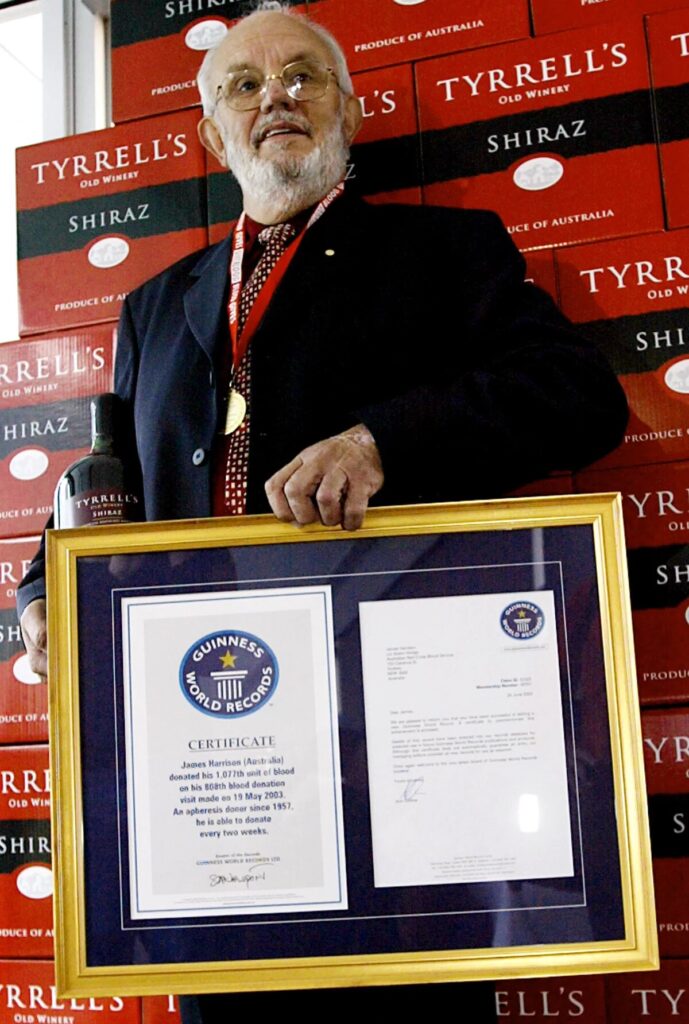
For over six decades, Harrison donated blood plasma every two weeks until his retirement in 2018 at the age of 81. He made a record-breaking 1,173 donations during his lifetime, earning him recognition from the Australian Red Cross Blood Service, now known as Lifeblood. He held the world record for the most blood plasma donations from 2005 until an American donor surpassed him in 2022.
Despite his fear of needles, Harrison remained committed to his mission, often saying, “It does not hurt, and the life you save could be your own.” His humility and dedication made him a national icon, and he was awarded the Medal of the Order of Australia (OAM) in 1999.
Beyond the numbers, Harrison’s impact was deeply personal. His daughter, Tracey Mellowship, and two of his grandchildren benefited from the Anti-D injections that his blood helped create. “He was always proud to have saved so many lives,” Mellowship said in a statement. “He never thought of it as a sacrifice—he simply wanted to help.”
Each year, fewer than 200 Anti-D donors in Australia help around 45,000 mothers and their babies. Harrison’s contributions not only helped those in need but also showed the importance of blood donation.
Researchers at the Walter and Eliza Hall Institute of Medical Research are working alongside Lifeblood to replicate the Anti-D antibodies in the lab. Lifeblood’s research director, David Irving, described this effort as the “holy grail” of medical research. The goal is to create a synthetic version of Anti-D, ensuring that pregnant women worldwide can access this life-saving treatment, regardless of donor shortages.
Scientists believe that Harrison’s unique blood composition may have been influenced by the transfusion he received as a teenager, but the exact reason remains unknown. Regardless of the origin, his selfless commitment turned what could have been a simple medical anomaly into a global medical breakthrough.
James Harrison is survived by his daughter, two grandsons, and four great-grandchildren. His contributions will continue to be felt for generations, as families around the world owe their children’s survival to his generosity.
His passing marks the end of an era, but his legacy as the man with the golden arm lives on through the millions of lives he helped save. The world has lost a true hero, but his story will continue to inspire countless others to donate blood and save lives.