Canada cut its tariff on Chinese EVs from 100% to 6.1% in January 2026, opening the border to up to 49,000 Chinese-made electric vehicles per year. Prime Minister Mark Carney announced the deal during a state visit to Beijing, calling it a new “strategic partnership” with China. The move breaks with Washington’s hardline stance and could bring affordable EVs some priced under CA$35,000 ($25,300 USD) to Canadian roads as early as mid-2026.
- Canada-China EV Trade Deal: Key Facts at a Glance
- What the Deal Actually Says
- Why Canada Changed Course
- Which Chinese EV Brands Are Coming to Canada?
- What About the US$5,000 EV Rebate?
- Agricultural Wins: Canola, Lobster, and Crab
- Jobs, Joint Ventures, and the Investment Promise
- How the U.S. Is Reacting
- Political Opposition Inside Canada
- Timeline: When Will Chinese EVs Arrive in Canada?
- What Competitors Miss and What This Means for You
- Related Reading on MyElectricSparks
- Frequently Asked Questions (FAQ)
- 1. When will Chinese EVs be available in Canada?
- 2. How much will Chinese EVs cost in Canada?
- 3. Can I get the CA$5,000 EV rebate on a Chinese EV?
- 4. Is BYD coming to Canada?
- 5. What did Canada get in return from China?
- 6. Does the deal affect U.S.-Canada trade relations?
- 7. Will Chinese EVs be safe and reliable for Canadian roads?
- 8. What happens if the Conservatives win the next election?
- Bottom Line
This is not a small policy tweak. Canada had imposed a 100% surtax on Chinese EVs in October 2024, mirroring U.S. tariffs. Less than 15 months later, that policy reversed. The deal covers battery-electric, plug-in hybrid (PHEV), and hybrid models. It also unlocks major agricultural concessions from China and signals a new direction for Canada’s trade strategy as U.S. tariff threats continue to pressure the economy.
Canada-China EV Trade Deal: Key Facts at a Glance
| Detail | Figure |
| New EV tariff rate | 6.1% (Most Favoured Nation) |
| Previous tariff rate | 100% (surtax imposed Oct 2024) |
| Annual import quota (2026) | 49,000 vehicles |
| Quota by 2030 | 70,000 vehicles |
| First half-year quota (Mar–Aug 2026) | 24,500 permits |
| Price target (by Year 5) | >50% of imports under CA$35,000 |
| Canadian EV rebate eligibility | No Chinese EVs excluded from CA$5,000 rebate |
| China canola tariff reduction | ~85% → 15% |
| Joint venture requirement | Within 3 years of signing |
What the Deal Actually Says
The Canadian government published the final regulations in the Canada Gazette on March 11, 2026. Effective March 1, 2026, the 100% supplementary surtax on Chinese EVs is repealed and replaced with a quota-based system. The first tranche of 24,500 permits runs from March 1 to August 31, 2026. A second block of 24,500 permits opens on September 1, 2026, and runs through February 28, 2027. Any unused permits from the first period carry forward.
Permits are issued on a first-come, first-served basis with no predetermined cap per automaker, though temporary limits may apply in the first 6 months. Eligible vehicle types include:
- Battery electric vehicles (BEVs)
- Plug-in hybrid electric vehicles (PHEVs)
- Standard hybrid electric vehicles (HEVs)
Critical caveat: The affordability rule requiring more than half of imports to be priced under CA$35,000 does not apply in Year 1. It kicks in by Year 5. The CA$35,000 threshold is also based on import price, not retail price. Dealers will add margins, taxes, and compliance costs, so the sticker price buyers see will be higher. This is a gap that other outlets haven’t clearly explained.
Why Canada Changed Course
3 forces drove this reversal:
- U.S. tariff pressure on Canada: Trump-era tariffs threatened Canadian exports across sectors. Diversifying trade partners, including China, became a strategic priority for Carney’s government.
- EV affordability gap: The average new EV in Canada sells above CA$60,000. Most households cannot afford this. Chinese EVs, some priced under CA$30,000, address this gap directly.
- Agricultural lobbying: Western Canadian canola farmers lost billions when China imposed tariffs of ~85%. The new deal cuts that tariff to 15%, providing immediate relief.
The Carney government framed this as an economic sovereignty move. With Washington imposing tariffs on Canadian goods and threatening to renegotiate USMCA, Ottawa chose to broaden its trading relationships rather than remain locked in the U.S. orbit.
Which Chinese EV Brands Are Coming to Canada?
BYD
BYD (Build Your Dreams) is the world’s largest EV manufacturer, delivering 4.6 million vehicles in 2025 alone, of which 2.3 million were fully electric. It has a significant regulatory head start in Canada: the company is already listed in Transport Canada’s Appendix G registry, which covers compliance with the Canadian Motor Vehicle Safety Standards (CMVSS). Transport Canada paused new Appendix G applications for passenger vehicles in 2025, so BYD’s existing listing gives it a lead over newer applicants.
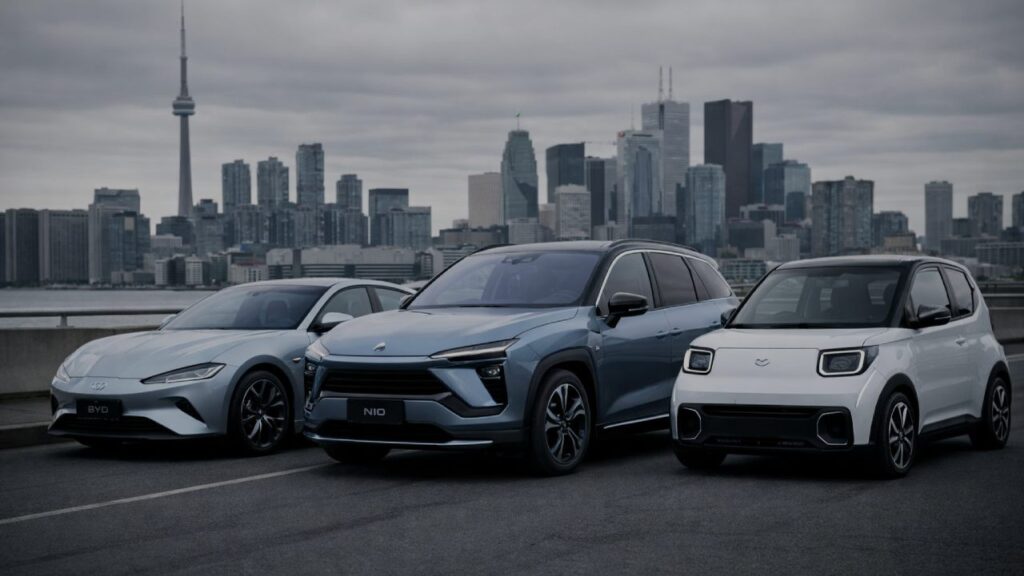
BYD registered vehicles from both its Shenzhen and Xi’an facilities for export to Canada. Key models expected:
- BYD Seagull / Dolphin Mini: Under CA$30,000, this compact city EV could be Canada’s most affordable new electric car.
- BYD Seal: A Tesla Model 3 rival with 500+ km range.
- BYD Sealion 7: A mid-size crossover SUV targeting family buyers.
BYD Executive Vice-President Stella Li told Bloomberg that the company is actively considering building a Canadian manufacturing plant but said BYD would insist on full ownership rather than a minority joint venture.
Tesla, Volvo, and Polestar: The Early Winners
Counterintuitively, the first beneficiaries of the quota may not be Chinese-branded EVs at all. Tesla manufactures some Model Y units at its Shanghai Gigafactory for export to Canada. Volvo’s EX30 and Polestar’s Polestar 2 are also built in China. These 3 brands are frontrunners for the first 24,500 permits because they already have established Canadian dealer networks and regulatory approvals in place.
Chery, Geely, and Xpeng
Canadian Industry Minister Melanie Joly met with both BYD and Chery executives during the Beijing visit. Chery offers affordable EVs and has international market experience. Geely’s British brand Lotus expects to begin delivering its Chinese-made Eletre electric SUV in Canada. Xpeng is positioned as a premium Tesla alternative but may enter later due to its higher price points.
What About the US$5,000 EV Rebate?
No Chinese-built EVs do not qualify for Canada’s CA$5,000 Electric Vehicle Availability Program (EVAP) rebate. The rebate applies only to vehicles from countries with which Canada has free trade agreements. China is not among them. This limits Chinese EV competitiveness against vehicles from South Korea (Hyundai, Kia) and other free-trade partners.
A BYD Seagull priced at CA$28,000 before import costs, dealer margin, and taxes could realistically land at CA$35,000–38,000 retail without the rebate a Hyundai Ioniq 6 buyer would receive. This is a material pricing disadvantage that the Carney government has not addressed publicly.
Agricultural Wins: Canola, Lobster, and Crab
The EV deal is paired with 3 major agricultural concessions from China:
- Canola seed: Tariff drops from ~85% to 15%, restoring a critical export market for Prairie farmers.
- Lobster: Existing restrictions on Canadian lobster exports to China are lifted.
- Crab: Export restrictions removed, benefiting Atlantic Canadian fisheries.

These concessions matter because China imposed steep tariffs on canola in 2024, costing Western Canadian farmers billions in lost revenue. The relief is effective immediately.
Jobs, Joint Ventures, and the Investment Promise
The deal includes a requirement for Chinese automakers to establish joint ventures for vehicle or battery production inside Canada within 3 years. The Prime Minister’s Office described this as a mechanism to “drive considerable new Chinese joint-venture investment in Canada.”
Industry analysts say this is the most important clause in the deal. It follows a model used in Europe and Southeast Asia, where market access was exchanged for local manufacturing and technology transfer. If Chinese automakers establish assembly or battery plants in Canada, it creates jobs and builds domestic supply chain capacity.
Canadian autoworkers union Unifor is skeptical. President Lana Payne said “vague promises of future investment offer no meaningful protection for workers facing immediate job loss.” The Detroit Three GM, Ford, and Stellantis also oppose the deal, warning it could cost Canada its North American auto supply chain role.
How the U.S. Is Reacting
The deal leaves the United States as the only major automotive market that fully blocks Chinese EVs. Chinese automakers already have market share in Latin America, Australia, Europe, and parts of Asia.
Tu Le, managing director of Sino Auto Insights, said: “The worst case scenario is GM and Ford effectively lose the Canadian market. The countdown clock is on in the United States. It just got louder with Canada’s announcement.”
The U.S. Select Committee on China, chaired by Rep. John Moolenaar, expressed concern on social media. USMCA renegotiation, scheduled to begin in summer 2026, will likely put this deal front and center in talks between Washington and Ottawa.
Political Opposition Inside Canada
Canada’s Conservative Party leader Pierre Poilievre opposes the deal. His plan: scrap the quota, align Canadian tariffs on Chinese goods with U.S. rates, and ban vehicles with software connected to China or Russia. Poilievre argues this would unlock tariff-free access to the U.S. market, which is more valuable than access to Chinese-made EVs.
Final regulations published in the Canada Gazette confirmed that no affordability requirement applies in Year 1. Critics say this contradicts the government’s core messaging that the deal is about making EVs affordable for working Canadians.
Timeline: When Will Chinese EVs Arrive in Canada?
| Date | Milestone |
| January 16, 2026 | PM Carney announces deal in Beijing |
| March 1, 2026 | Quota system takes effect; surtax repealed |
| March 2026 | First 24,500 import permits issued (first-come basis) |
| Mid-2026 | Tesla, Volvo, Polestar deliveries expected under new quota |
| Late 2026 | BYD, Chery, Geely target Canadian market entry |
| September 1, 2026 | Second 24,500-permit tranche opens |
| 2027–2028 | Chinese automakers must establish joint ventures |
| 2030 | Quota expands to 70,000 EVs/year; >50% must be under CA$35,000 |
What Competitors Miss and What This Means for You
Most coverage of this deal has 3 clear weaknesses:
- The affordability loophole: Outlets reported that EVs under CA$35,000 would enter the market. Few noted this rule does not apply in Year 1 and is based on import price, not retail price.
- Who actually gets the first permits: The first beneficiaries are Tesla, Volvo, and Polestar not BYD or Chery. Most consumers don’t know this.
- The rebate exclusion: Chinese EVs cannot access Canada’s CA$5,000 EVAP rebate, significantly narrowing the price advantage over Korean competitors.
For Canadian buyers, the practical takeaway is this: do not expect a flood of cheap Chinese EVs by summer 2026. The first permits will largely go to familiar global brands building in China. True Chinese-brand competition, BYD Seagull, Chery Omoda, is a late-2026 to 2027 story at the earliest.
Related Reading on MyElectricSparks
Explore more EV and clean energy coverage:
- China Launches World’s Longest-Range SUV EV 1,058 Miles on One Charge
- Xiaomi SU7 Reports 94.5% Battery Health After 265,000 km
- Kawasaki Launches World’s First Commercial Gas Engine for 30% Hydrogen Blend
- Solar Tracking Device Project: A Step-by-Step Guide
Frequently Asked Questions (FAQ)
1. When will Chinese EVs be available in Canada?
Canadian dealers could receive Chinese-made EVs as early as mid-2026, but the first units will likely be Tesla Model Y and Volvo EX30 units built in China, not BYD or Chery models. Chinese-brand EVs are targeting a late 2026 or 2027 entry.
2. How much will Chinese EVs cost in Canada?
Retail prices will depend on dealer margins, import logistics, and taxes. A BYD Seagull has a base import price under CA$28,000, but the street price in Canada is expected to be CA$33,000–38,000 after all costs. This still makes it one of the most affordable new EVs on the Canadian market.
3. Can I get the CA$5,000 EV rebate on a Chinese EV?
No. The federal EVAP rebate applies only to EVs from countries with which Canada has free trade agreements. China is excluded. This means a Chinese EV buyer pays CA$5,000 more out of pocket versus an eligible Hyundai or Kia buyer.
4. Is BYD coming to Canada?
Yes, BYD is actively preparing for entry into the Canadian market. The company has already registered vehicles with Transport Canada and submitted import permit applications. BYD is also considering building a manufacturing plant in Canada, though it insists on full ownership of any facility.
5. What did Canada get in return from China?
3 major concessions: canola seed tariffs cut from ~85% to 15%, restrictions lifted on Canadian lobster exports, and restrictions removed on Canadian crab exports. China also committed to supporting joint-venture investments in Canada’s EV and battery sectors.
6. Does the deal affect U.S.-Canada trade relations?
Yes, significantly. The U.S. has been trying to create a unified North American front against Chinese EVs. Canada’s deal breaks that alignment. USMCA renegotiation talks, set to begin in summer 2026, will likely see the U.S. push back on this deal as part of broader trade negotiations.
7. Will Chinese EVs be safe and reliable for Canadian roads?
Chinese EVs must meet all Canadian Motor Vehicle Safety Standards (CMVSS) before receiving sales approval. Vehicles also require battery safety certification, charging interface compliance, and data/software audits. BYD’s Blade Battery has passed fire, penetration, and crush tests. Winter performance in Canada’s cold climate remains the main area to watch, as lithium batteries lose 20–40% range in sub-zero temperatures.
8. What happens if the Conservatives win the next election?
The Conservatives have pledged to scrap the quota entirely and realign Canada’s tariffs on China with U.S. rates. This would effectively reverse the deal. The political durability of the agreement depends on the outcome of the next federal election.
Bottom Line
Canada’s decision to reopen its market to Chinese EVs is the biggest shift in North American clean vehicle policy since the U.S. imposed its 100% tariffs in 2024. For consumers, it promises more choice and eventually lower prices. For autoworkers and the Detroit Three, it raises genuine competitive concerns. Canada’s trade strategy signals a deliberate pivot away from Washington’s trade agenda.
The deal’s real impact will be measured in 2027 and 2028 when Chinese brands have actually arrived, joint venture commitments are tested, and Canadian buyers decide whether to choose a BYD over a Hyundai. For now, the door is open. What comes through it remains to be seen.