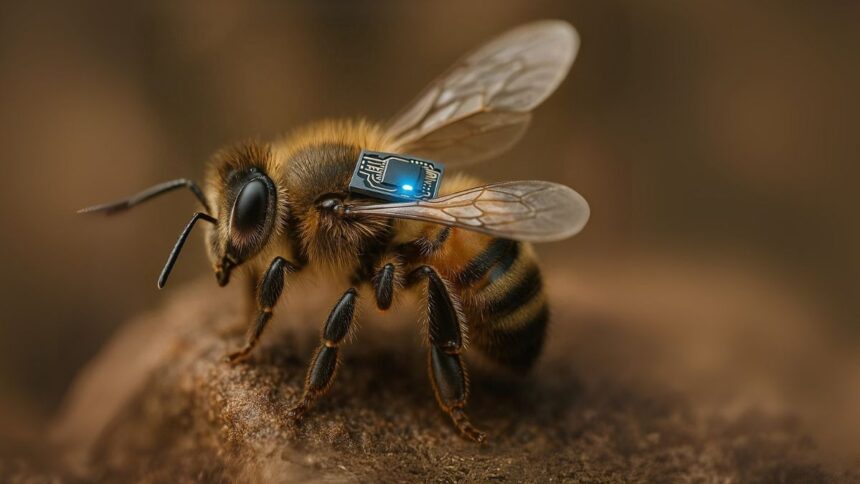
Scientists at the Beijing Institute of Technology have created the world’s lightest insect brain controller. This small device, weighing just 74 milligrams, is light enough to be carried by a honeybee without affecting its flight. The breakthrough allows researchers to control the movement of live bees with a 90 percent success rate.
The tiny controller attaches to a bee’s back and uses three ultra-fine needles to pierce its brain. Once connected, the system sends electronic pulses that trick the insect’s senses and guide its flight in specific directions. During laboratory tests, the bees followed commands to turn, move forward, and retreat, showing how effective this technology could be in real-world scenarios.
According to the study published on June 11 in the Chinese Journal of Mechanical Engineering, this innovation outperforms earlier cyborg controllers that were heavier and less efficient. Professor Zhao Jieliang, who led the team, explained, “Insect-based robots inherit the superior mobility, camouflage capabilities, and environmental adaptability of their biological hosts,” Zhao said.
“Compared to synthetic alternatives, they demonstrate enhanced stealth and extended operational endurance, making them invaluable for covert reconnaissance in scenarios such as urban combat, counterterrorism, and narcotics interdiction, as well as critical disaster relief operations.”
This breakthrough has attracted attention worldwide because it takes biohybrid robotics to a level never seen before. Previously, similar experiments used beetles and cockroaches with heavier devices that often made the insects slow and fatigued. A model developed in Singapore, for example, weighed three times more than the Chinese version and limited the insects’ movement to crawling instead of flying.

Bees are more capable than other insects for such applications. They can fly long distances of up to five kilometers without resting and carry loads equivalent to 80 percent of their own body weight. This natural strength and endurance make them ideal for missions in places too dangerous or inaccessible for humans or large drones.
To build the device, Zhao’s team printed microelectronic circuits on a thin, flexible polymer film similar to the texture of insect wings. This ultra-light material houses various components, including an infrared receiver for remote communication.
The system was tested with nine different pulse settings, carefully matching electronic signals to the insects’ natural motor responses. Bees were able to change direction mid-flight with high precision, while cockroaches in earlier tests followed straight paths with minimal deviation.
According to South China Morning Post, the researchers believe this technology could eventually be used in military scouting, disaster relief, and other critical operations. Swarms of mind-controlled bees could navigate through rubble after earthquakes or enter tight spaces to locate survivors. In military applications, their small size and natural appearance could make them undetectable as surveillance tools.
The current system still requires wired power, which limits its range and deployment in open environments. A battery light enough for a bee to carry but strong enough to power the device has yet to be developed. Moreover, different insects respond differently to electronic signals, meaning the same controller may not work universally across species.
The project also raises serious ethical and privacy concerns. Turning insects into biological spy drones could lead to a future where swarms of tiny cyborgs are used for mass surveillance. Critics warn that such technology, if misused, could create a new type of monitoring system invisible to the human eye.
Professor Zhao acknowledges these concerns but emphasizes the potential benefits for humanitarian missions. “In future research, precision and repeatability of insect behaviour control will be enhanced by optimising stimulation signals and control techniques,” Zhao said.
“Expanding the functional modules of the control backpack will also improve environmental perception capabilities, allowing insect-based robots to perform better in complex operational settings such as reconnaissance and detection missions.”
The research team’s work has been compared to the fictional parasitic fungus cordyceps, known for taking control of insects in nature and inspiring the zombie virus in the popular series The Last of Us. But while this is science, not science fiction, the similarities shows how deeply this technology taps into nature’s most efficient systems.