Scientists have long known that studying in short, spaced sessions helps people remember better than cramming information at once. This principle, called the spacing effect, remains one of the most powerful ideas in learning science and supports the concept of memories stored through repeated exposure over time.
Now, a study from New York University (NYU) shows that this rule extends beyond the brain. Researchers found that ordinary human cells also follow patterns similar to memories stored when exposed to spaced signals. The study appeared in Nature Communications.
The NYU research team discovered that when chemical signals reach cells in short, spaced bursts instead of one continuous wave, cells respond more strongly and their response lasts longer. In simple terms, cells behave in a way similar to memories stored, responding better when signals arrive over time rather than all at once.
During the experiment, scientists grew non-neural human cells in petri dishes and inserted a reporter gene that glows when activated. They then exposed these cells to chemical signals that mimic learning conditions. When signals arrived in timed intervals, the glow became stronger and lasted longer, showing improved cellular response.
This finding suggests that memory-like behavior does not belong only to neurons. Regular cells found in skin or organs can also detect timing patterns and adjust their reactions, much like memories stored through repetition in human learning.
To understand how this process works, researchers used two compounds, forskolin and phorbol ester (TPA). These compounds activate internal pathways linked to memory. Forskolin triggers protein kinase A (PKA), while TPA activates protein kinase C (PKC). These enzymes carry signals from the cell surface to the nucleus and influence gene activity.
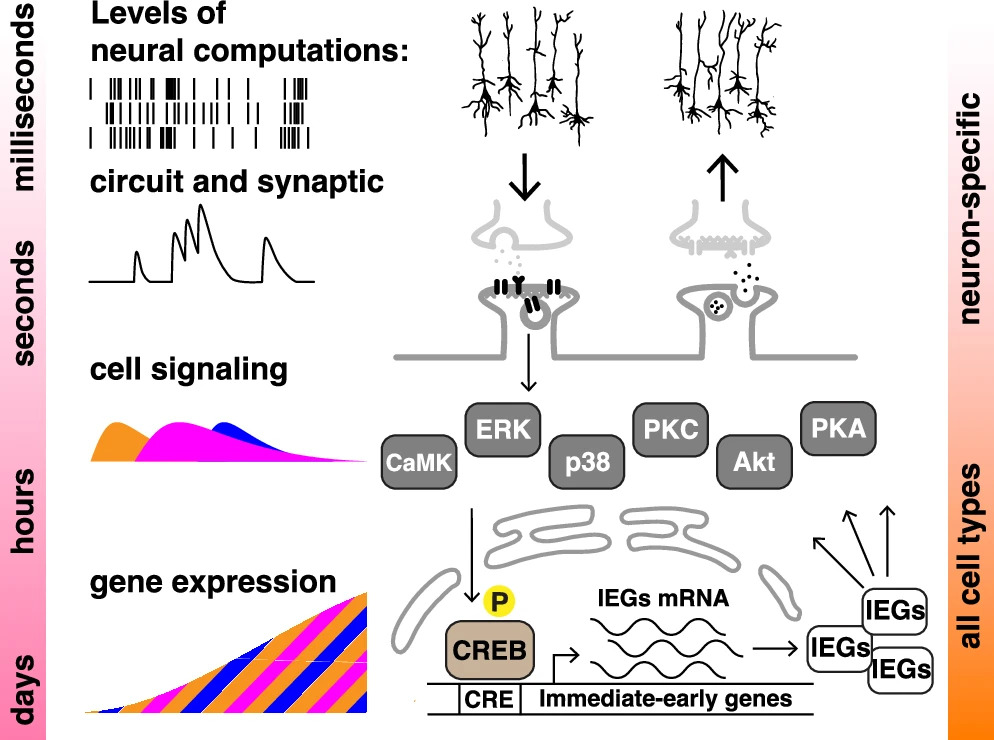
The team compared one long chemical signal with several short, spaced pulses. Results showed that spaced signals created a stronger and longer-lasting glow. This indicated that cells retained information about timing and patterns, reinforcing the idea of memories stored at a cellular level.
Dr. Nikolay V. Kukushkin, the study’s lead author, explained that learning from spaced repetition may be a basic property of all living cells, not just brain cells.
Researchers also identified two key proteins, ERK and CREB, as central to this process. These proteins help form long-term memory in neurons. When scientists blocked ERK or CREB, cells lost their ability to respond strongly to spaced signals, showing that the mechanism behind memories stored exists across many cell types.
Spaced signals caused stronger and longer activation of ERK and CREB compared to continuous signals. This shows that timing plays a critical role even at the smallest biological level.
The findings could influence medicine, drug development, and education. Doctors may design treatments based not only on dosage but also on timing. Smaller, well-timed doses could produce better and longer-lasting results.
This research also supports how humans learn. Spaced repetition helps create stronger memories stored over time. If the same principle applies across different cell types, learning may be a universal biological function.
Dr. Kukushkin noted that cells respond not only to the strength of a signal but also to its rhythm and pattern, which can shape long-term behavior.
The study took place in controlled lab conditions using cultured human cells. Real tissues are more complex, with many interacting signals. Future research will explore whether similar timing effects appear in living tissues, organ systems, or entire organisms.