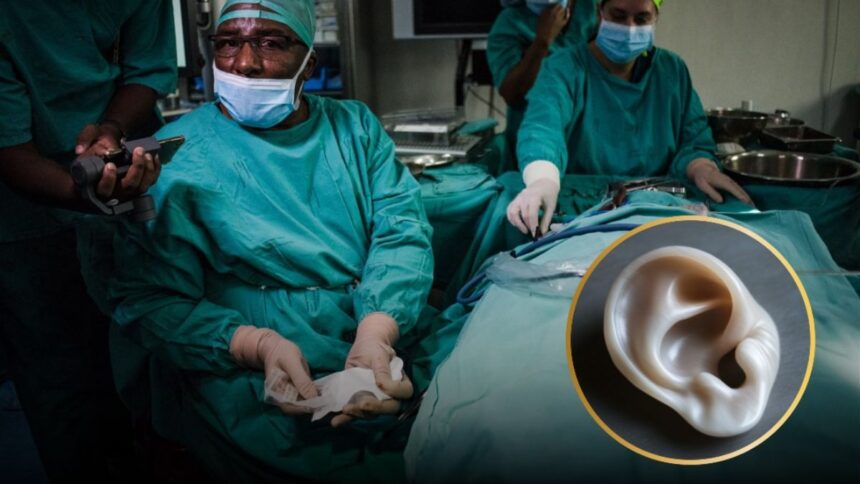
South African surgeon Professor Mashudu Tshifularo and his team at the University of Pretoria successfully performed the world’s first middle ear transplant using 3D-printed bones.
This surgery gave new hope to millions suffering from conductive hearing loss, especially those affected by birth defects, infections, injuries, or other conditions damaging the tiny bones inside the ear.
The surgery, first conducted in 2019, took place at the Steve Biko Academic Hospital in Pretoria. It involved replacing the middle ear’s three smallest bones the hammer, anvil, and stirrup with titanium parts made from 3D-printing technology.
These bones, also known as the ossicles, are responsible for transmitting sound from the outer ear to the inner ear. When damaged, they can lead to hearing loss. Until now, treatments were limited, often involving risky or unsuccessful surgeries.
Professor Tshifularo and his team developed a way to print these bones using biocompatible titanium and tailor each part to match the patient’s anatomy. The process was made possible with 3D-scanning technology, allowing doctors to study the structure of a damaged ear in detail before designing and printing the perfect match.
One of the first people to benefit from this medical innovation was Thabo Moshiliwa, a 40-year-old man who lost hearing after injuring his middle ear. The procedure lasted almost two hours and was performed through a small camera, or endoscope, which made the surgery less invasive and reduced risks such as facial nerve damage and scarring.
Speaking to the media after the operation, Professor Tshifularo expressed excitement over the success of the surgery. He said, “I’ve just done a middle ear transplant the first in the world, pioneering restoring middle ear bones when you have conductive hearing loss. The operation went fantastically well and we are very excited.”
A second surgery was planned for Simon July Bohale, a 62-year-old man who had struggled with ear problems since birth. He was born without a fully developed middle ear and had already gone through two surgeries with no success.
“I’ve gone through two surgeries already, I went to traditional healers but nothing has helped me. I have hearing problems and my right ear pains as well. I’m very excited and I’m happy that my life will soon change,” Bohale said before the surgery.
The procedure aimed to simplify and improve surgeries like ossiculoplasty and stapedectomy, which reconstruct or replace damaged ear bones. Usually, surgeries can be complex and carry high risks, including permanent facial paralysis if the nearby facial nerve is harmed. This new method using 3D-printed bones reduced these risks and allowed surgeons to perform the procedure even on newborn babies.
“This innovation, the solution for hearing loss, comes as the first in the world, which calls for celebration,” said MEC for Health Gwen Ramokgopa. “We are here to congratulate Professor Tshifularo and the team…because they have been working on this for the past 10 years. You have tested it and now you are going to implement it.”
Professor Tshifularo, who leads the Department of Otorhinolaryngology at the University of Pretoria said, “3D technology is allowing us to do things we never thought we could.”
He also made it clear that while the surgery was successful, further progress would need funding. His team hoped that donors and the government would help support this breakthrough so more patients across South Africa and around the world could benefit from it.
With hearing loss being a major health problem globally, especially in developing countries where access to advanced medical care is limited, this low-cost, personalized treatment using 3D printing could change many lives.