
Scientists have found that two common cancer drugs may help treat Alzheimer’s disease. These drugs, already approved by the U.S. Food and Drug Administration (FDA), have shown strong results in mice by improving memory and reducing brain damage.
The study, done by researchers from the University of California, San Francisco (UCSF) and the Gladstone Institutes, offers new hope for millions of people suffering from this brain disease. The study has been published in the journal Cell.
The two drugs are letrozole and irinotecan. Doctors usually use letrozole to treat breast cancer, and they use irinotecan for colon and lung cancers. Because the U.S. Food and Drug Administration has already approved these drugs, scientists hope they can move to human trials much faster than brand-new medicines. This approach can save time and money in the search for an effective treatment for Alzheimer’s.
Dr. Marina Sirota, a computational biologist at UCSF and co-author of the study, said, “We didn’t expect cancer drugs to come up as the most promising.”
She explained that their research started by studying how Alzheimer’s disease changes gene activity in the brain. The team then used a medical database called the Connectivity Map to search for drugs that could reverse those gene changes.
Out of more than 1,300 drugs, only 90 seemed to help. And five of those showed a reduced risk of Alzheimer’s in real patients. Eventually, letrozole and irinotecan were picked as the best candidates.
Dr. Yadong Huang, a professor of neurology at UCSF and another co-author, explained the advantage of using existing drugs. “Developing a new drug can take hundreds of millions, or even billions, of dollars, and more than 10 years. For this repurposed drug, it just takes two or three years to go to clinical trial, and the cost is much, much lower.”
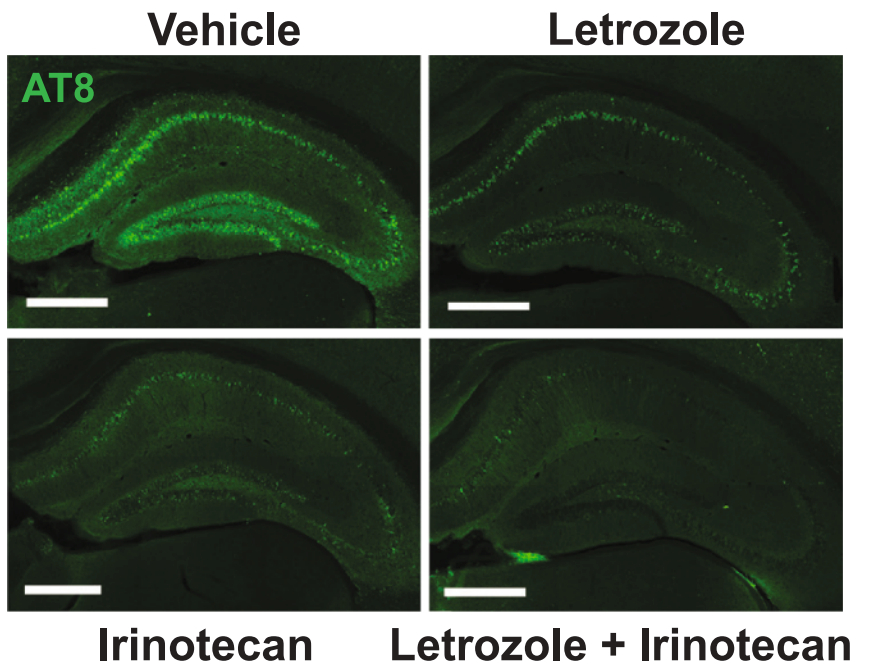
To confirm the findings, the researchers examined the medical records of cancer patients who took these drugs. Interestingly, women who took letrozole for breast cancer had a lower risk of Alzheimer’s, according to a 2020 study. Similarly, a 2021 study found that patients with colorectal cancer who took irinotecan also had a lower risk of Alzheimer’s.
After choosing the two drugs, the team tested them on mice that had symptoms similar to Alzheimer’s. The results were promising. The drugs helped reduce harmful tau proteins in the brain. These proteins are often found in high amounts in people with Alzheimer’s and are known to damage brain cells. The mice also performed better in memory and learning tests after taking the drugs.
The combination of both drugs worked well because each one helped different types of brain cells. Letrozole affected the neurons, or nerve cells, and irinotecan helped with glial cells, which support the brain and nervous system. Alzheimer’s disease harms both of these cell types, so a combination therapy could be more effective.
Dr. Huang said, “This dual-drug therapy allowed us to target different brain cells. Letrozole helped neurons, while irinotecan affected glial cells. It’s a big step in tackling Alzheimer’s from multiple angles.”
Although the results in mice were very promising, experts say more work is needed. Human clinical trials are the next step. Letrozole and irinotecan do have side effects. Letrozole can cause hot flashes, and irinotecan can lead to serious diarrhea, nausea, and vomiting. Doctors must carefully consider whether the benefits of the treatment are greater than the risks, especially in older patients.
Dr. Sirota said, “These drugs have huge side effects, so you need to always balance and figure out whether those types of side effects would be acceptable for someone with Alzheimer’s. It’s not that it’s a slam dunk.”

The exact reason these cancer drugs help with Alzheimer’s disease remains unclear. Letrozole blocks estrogen, a hormone that controls many genes, and may reduce brain inflammation. Irinotecan might also stop glial cells from overgrowing, which causes swelling and damage in the brain.
Dr. Melanie McReynolds from Penn State University, believe that the drug combo might improve how brain cells produce energy by fixing glucose metabolism. She said this process is important for brain cell communication, and that it gets weaker with age, disease, and stress. “With aging, with stress, with diseases, that line of communication is disrupted,” she said. “This drug combo might help reverse that.”
Alzheimer’s disease is becoming a bigger problem. More than 55 million people already have the disease, and experts expect that number to double in the next 25 years. A treatment that can slow or reverse the symptoms will make a huge difference in global health.
Dr. Sirota said, “If completely independent data sources, such as single-cell expression data and clinical records, guide us to the same pathways and the same drugs, and then resolve Alzheimer’s in a genetic model, then maybe we’re on to something. We hope researchers can swiftly translate this work into a real solution for millions of patients with Alzheimer’s disease.”