
Researchers in Switzerland have developed a new kind of “living material” that can capture carbon dioxide (CO2) from the air — just like trees do. This new material could be used in buildings to help fight climate change.
The invention uses blue-green algae, known as cyanobacteria, which are some of the oldest life forms on Earth. These bacteria use photosynthesis to turn sunlight, CO2, and water into oxygen and sugar.
The team behind this project is from ETH Zurich, a top science and technology university in Switzerland. Their findings were published in the journal Nature Communications. The material not only absorbs CO2 but also turns it into solid minerals like limestone. This process makes the material stronger and stores the carbon in a safe and stable form for a long time.
Yifan Cui, a doctoral student in macromolecular engineering at ETH Zurich and one of the study’s lead authors, said, “Cyanobacteria are among the oldest life forms in the world. They are highly efficient at photosynthesis and can utilize even the weakest light to produce biomass from CO2 and water.”
The base of the material is a hydrogel, which is like jelly but made of cross-linked molecules filled with water. This hydrogel supports the growth of cyanobacteria. The researchers designed it so that light, water, and carbon dioxide could easily reach the bacteria living inside.
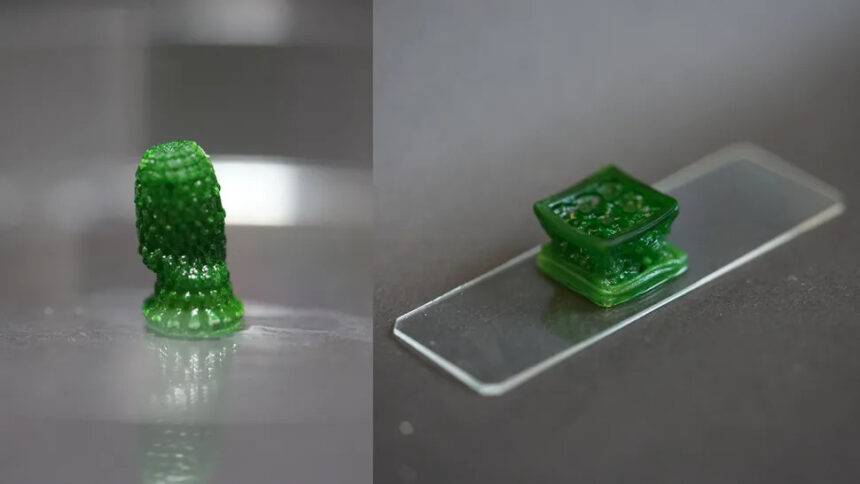
They also used 3D printing to make the shape of the gel more suitable for the bacteria’s survival. The goal was to increase the surface area and allow more light and nutrients to reach the algae.
To help the bacteria turn CO2 into solid materials, the scientists bathed the hydrogel in artificial seawater. This seawater contained nutrients like calcium and magnesium, which helped the cyanobacteria turn carbon dioxide into limestone and other minerals.
Mark Tibbitt, associate professor of macromolecular engineering at ETH Zurich and co-author of the study, said, “The material can store carbon not only in biomass but also in the form of minerals — a special property of these cyanobacteria. As a building material, it could help to store CO2 directly in buildings in the future.”
Without this mineral process, the material would stay soft and jelly-like. But when the bacteria turn CO2 into solid minerals, they form a kind of skeleton inside the material. This makes it stronger and more useful for construction.
The team tested the material for 400 days straight. It continued to capture carbon dioxide throughout this time. They found that the material stored about 26 milligrams of CO2 per gram of the material — a very high rate compared to other natural carbon capture methods. This number is also better than many chemical methods currently in use.
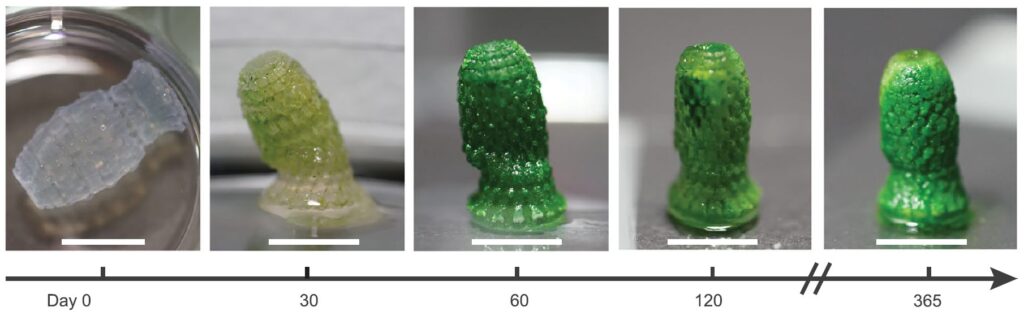
“The material remained efficient in carbon sequestration throughout the entire incubation period,” the researchers wrote in their study. The green color of the material becomes brighter over time. This shows that it is storing CO2 in the form of new plant material.
However, the researchers found that this part of the process slows down after about 30 days. Even though the bacteria stop growing quickly, the material still keeps turning CO2 into solid minerals, which is more important for long-term storage.
To show how this new material can be used in the real world, the team created two tree trunk-like objects and displayed them at an architecture exhibition in Venice, Italy. These objects can each absorb up to 18 kilograms of CO2 per year, which is as much as a 20-year-old pine tree. These structures show how buildings of the future could include materials that clean the air just by being there.
Right now, the scientists are working on how to provide nutrients to the material if it’s used as a coating on buildings. They are also thinking about ways to improve the bacteria so they can absorb even more CO2.
“We see our living material as a low-energy and environmentally friendly approach that can bind CO2 from the atmosphere and complement existing chemical processes for carbon sequestration,” said Tibbitt.