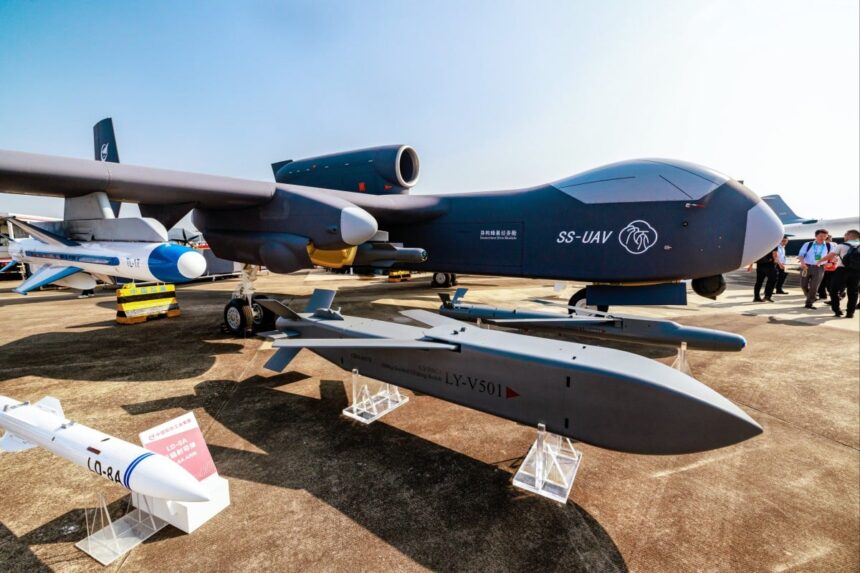
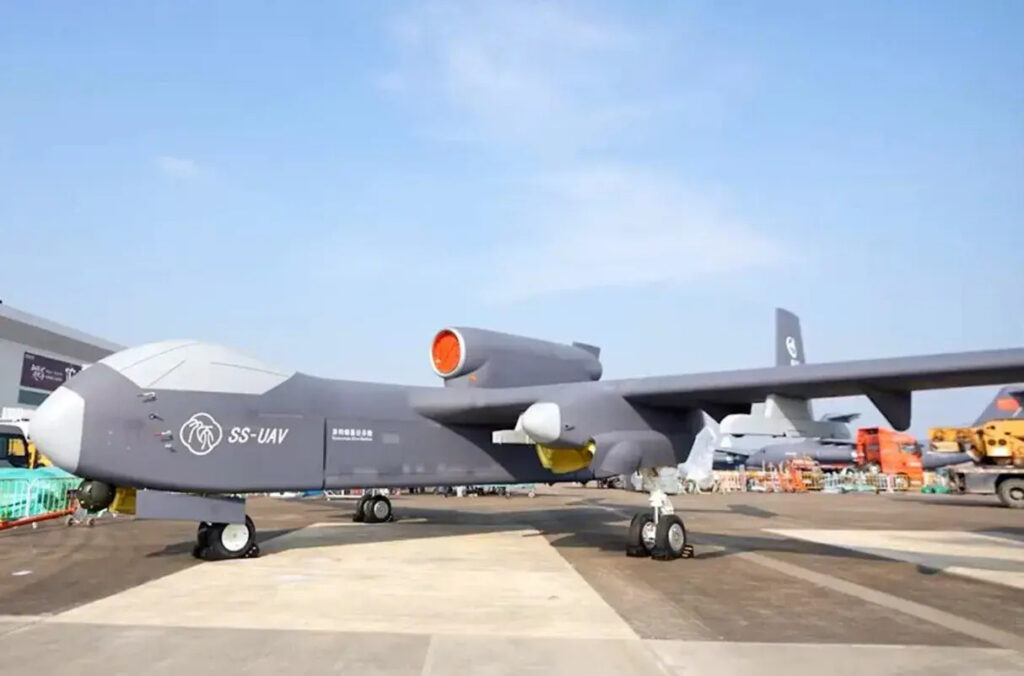
China has revealed a powerful new weapon in its growing drone arsenal, a massive unmanned “mothership” aircraft called Jiu Tian, meaning “High Sky.” This new drone carrier can release up to 100 smaller kamikaze or reconnaissance drones during a single mission, opening the door to large-scale swarm tactics that could transform battlefields.
The Jiu Tian unmanned aerial vehicle (UAV) was set to fly its first official mission by the end of June, according to China Central Television (CCTV). Built by the Aviation Industry Corporation of China (AVIC), the drone was first shown at the Zhuhai Air Show in November 2024.
The platform is designed to extend China’s unmanned combat range, especially in contested areas of the Asia-Pacific. Jiu Tian has a maximum range of 7,000 kilometres (4,350 miles). It can also fly at altitudes of 15,000 meters (50,000 feet). Therefore, it serves as a high-altitude, long-endurance UAV. It can handle both surveillance and offensive missions.
Its wingspan measures 25 meters (82 feet). The drone can take off weighing 16 tonnes. It carries payloads of up to 6 tonnes.
The Jiu Tian’s uniqueness is its role as a “drone carrier.” From compartments under its fuselage, it can release as many as 100 smaller drones mid-flight. These include loitering munitions, kamikaze drones, and reconnaissance UAVs, all designed to overwhelm enemy defenses through swarm tactics.
Chinese state media compared the release to “bees leaving a hive,” showing promotional videos of dozens of drones deploying simultaneously. This tactic aims to provide the People’s Liberation Army (PLA) with massed reconnaissance or saturation attacks. These attacks target enemy positions far beyond its shoreline.
Beyond its swarm capability, engineers designed the Jiu Tian for modularity. They can switch the payload within two hours. This allows the drone to adapt for different missions. These include electronic warfare, precision strike and support, maritime surveillance, and emergency rescue.
It can also carry a mix of air-to-air, anti-ship, and air-to-ground missiles. Additionally, it can handle guided bombs weighing up to 1,000 kg (2,200 lbs). It can also act as a communications relay. This extends the range of the smaller drones it releases. This flexibility means the Jiu Tian is not limited to combat. It could also play roles in civilian and disaster-response missions.
Tom Shugart, a senior fellow at the Center for a New American Security, told Newsweek, “It’s an interesting concept. However, without stealth, the enemy could destroy the mothership drone before it gets close enough to release its swarm. Still, it’s worth monitoring its progress.”
A retired U.S. Air Force instructor on social media added, “This is like trying to sneak into enemy airspace with a giant fuel tanker.” It’s simply not survivable without heavy support.” The PLA is rapidly expanding its naval and aerial capabilities, aiming to challenge U.S. dominance in the Asia-Pacific region.