
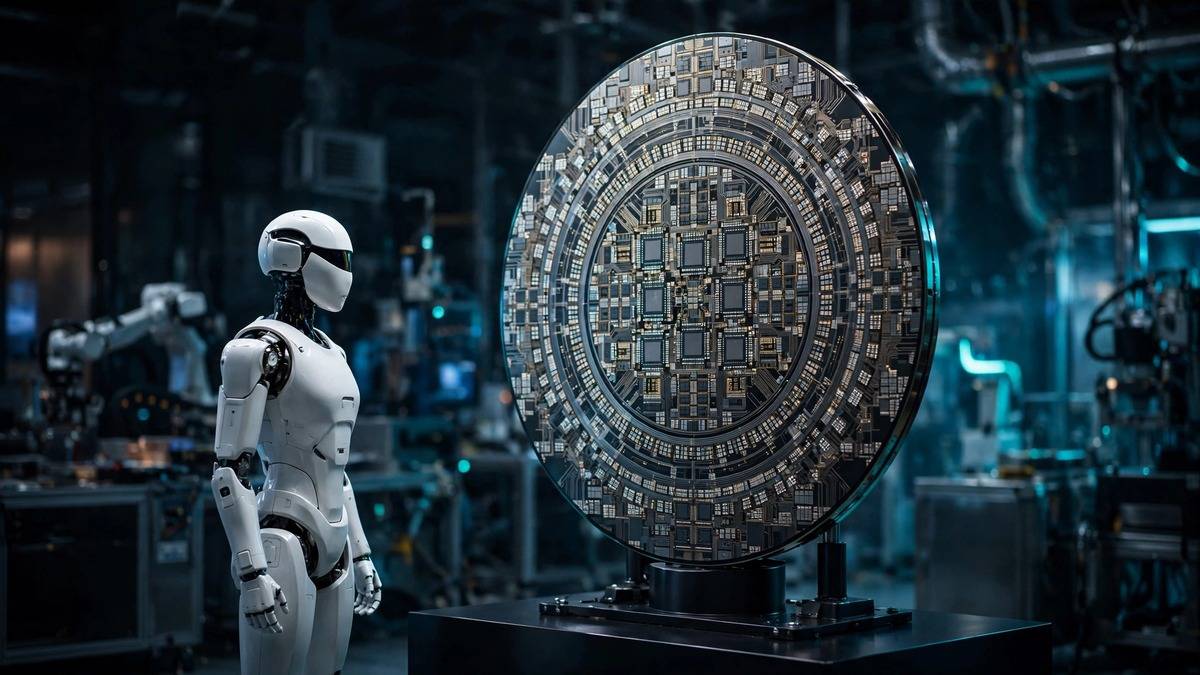
Elon Musk just made a bold call on the Tesla AI5 chip. On Oct 1, 2026, he announced on X that Tesla has cut the memory of its upcoming AI5 chip in half, from 144GB down to 72GB of LPDDR5. The AI6 chip got a trim too, dropping by a third to 144GB of LPDDR6 from 216GB. Musk says the move will have almost no effect on how the Optimus humanoid robot performs.

Memory might sound like a strange thing to cut from the Tesla AI5 chip. After all, more memory usually means a smarter machine. But Musk explained the logic in plain words. He wrote that this was the only way to get enough volume for Optimus production, and that it greatly reduces cost. In other words, Tesla would rather build far more chips with slightly less memory than build a few perfect ones.
The MES Times Analysis: This is the clearest signal yet that Tesla now thinks like a carmaker, not a chipmaker. Volume first, specs second.
The news was first detailed by wccftech, which noted that the Tesla AI5 was originally planned with 144GB of LPDDR5. That plan is now history. The chip keeps its half reticle design, with a large central compute die and 12 DRAM modules around it.
AI Stock Wire added useful background. Back in September 2025, Musk had said AI5 would carry nine times the memory of AI4. With AI4 sitting at 16GB, that worked out to 144GB. The new 72GB figure is exactly half of that earlier promise.
Trial production of the Tesla AI5 is already underway at the Samsung Taylor facility in Texas. Full volume production is expected in 2027. Tesla needs these chips in huge numbers, since they will power both the Full Self Driving system in its cars and the Optimus robot.
Why Memory Supply Forced the Move
Dataconomy reports that AI6 will lean heavily on SRAM, with about half of its TRIP AI compute accelerators dedicated to SRAM cache. That cache moves data far faster than DRAM for many jobs, which helps explain why Tesla feels safe cutting DRAM.
TeslaNorth points to the deeper reason: global memory supply. Musk noted that the world makes about 45 billion GB of DRAM per year. If humanoid robots ever reach the billions, memory becomes the true bottleneck, not chip speed.
Memory makers see it the same way. Micron recently estimated that each humanoid robot could eventually need around 200GB of DRAM plus terabytes of storage. The company called physical AI a major future driver of memory and storage demand.
Do the math at Tesla scale and the cut makes sense. Saving 72GB on every AI5 chip means the same memory supply can build roughly twice as many chips. For a company that wants Optimus everywhere, volume beats specs.
That hunger for volume shows up across Tesla’s plans, from private 5G for its cars and Optimus to new factory lines built for robots.
Why Optimus Will Barely Notice
Here is the part that surprises most people. Musk says the memory cut will have a negligible effect on Optimus performance. His reason is simple. Memory bandwidth matters more than total memory size, and Tesla held the bandwidth exactly constant.
Think of it like a highway. The number of lanes decides how fast traffic moves. The size of the parking lot matters far less. A robot that reads the world in real time needs data to flow fast, not to sit in storage.
The MES Times Analysis: If Musk is right, the whole industry has been overpaying for memory. Bandwidth is the real currency of real time AI.
The chip itself remains a beast. TSMC and Samsung will build AI5 on a 2nm process, delivering 2000 to 2500 TOPS of compute. A single chip roughly matches an NVIDIA H100. A dual chip setup can stand up to Blackwell.
The rest of the industry is chasing the same idea of doing more with less silicon, with China developing highly energy efficient AI microchips of its own.
The robot race is getting crowded too. A Chinese firm recently unveiled its first humanoid robot, built to challenge Optimus directly.
Others are solving the factory problem from a different angle, like the UBTech Walker S2 that can swap its own battery and keep working around the clock.

The MES Times Take
This is classic Musk. Trade a spec sheet number for real world scale. Most chipmakers would guard every gigabyte as a marketing win. Tesla just gave half of them up to build more robots at lower cost. That tells you exactly where the company sees the future. The race is no longer about who builds the biggest chip. It is about who puts intelligent machines into the most hands. And sometimes the smartest move is knowing what you can afford to lose. After all, a perfect chip that never ships helps no one.
Read also: Microsoft AI-powered versions of its internet browser, Bing and Edge
Read also: Scientists Built an AI Scientist That Designs and Tests Its Own Experiments
