
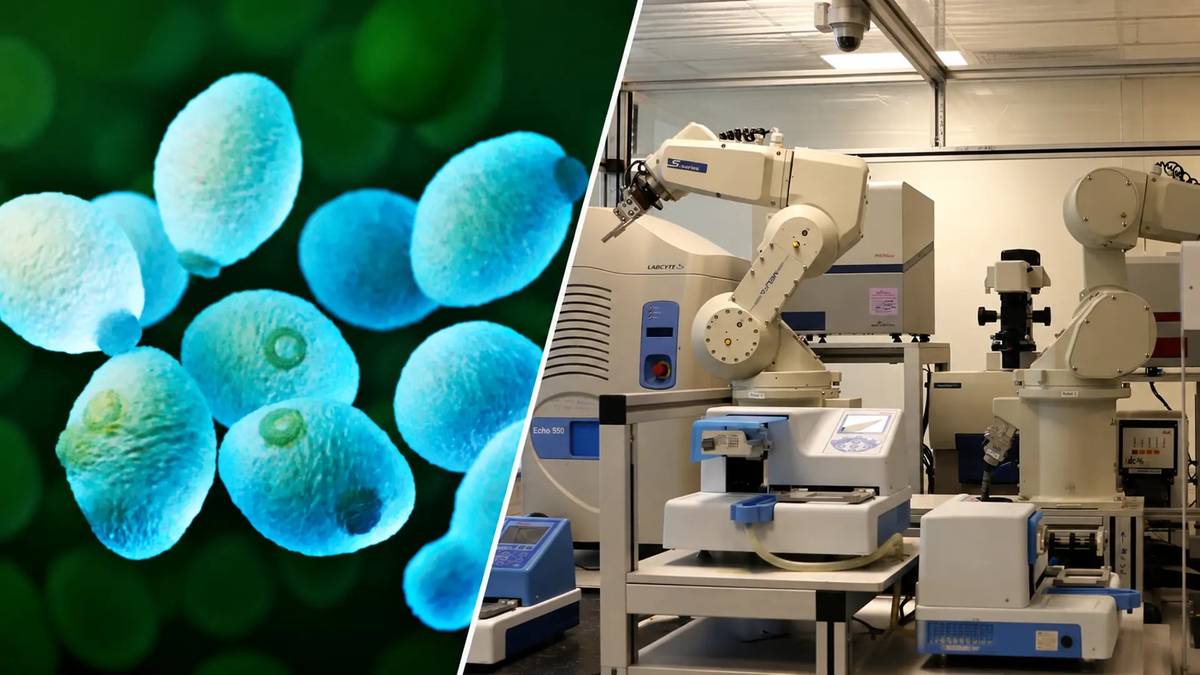
Imagine a scientist that never sleeps, never gets tired and can test hundreds of ideas before lunch. Researchers in Sweden have built something close to that dream. Their AI scientist can design its own experiments, run them and learn from the results, with very little help from humans.
The system was built at Chalmers University of Technology. It combines large language models, automated reasoning and robotic lab equipment into one closed loop. The team set it loose on a classic subject, brewer’s yeast, the tiny organism behind bread and beer. The AI was given the yeast genome, its metabolism and past research as background knowledge. From there it worked on its own. It picked interesting biological questions, suggested experiments, studied the outcomes and refined its ideas step by step.
The results were real. The AI scientist generated new biological knowledge about yeast and validated it through actual lab experiments. The study was published in the Journal of the Royal Society Interface. The lead researcher is Ievgeniia Tiukova, and the senior author is Professor Ross King, a pioneer in automated science.

Chalmers is not alone in this race. On September 23, 2026, Anthropic announced that its Claude agents had autonomously identified a new enzyme system similar to CRISPR, the tool scientists use to edit genes. The company calls the discovery ART. Humans still did the wet lab work to confirm it. Anthropic chief executive Dario Amodei said Claude may one day run lab equipment itself, “but we aren’t doing that today.” According to UNILAD Tech, the announcement shows how fast AI is moving into real scientific discovery.
A note of honesty is needed here. The Chalmers AI scientist worked in a narrow field. Yeast is well studied, and humans set up the whole laboratory before the AI took over. Minimal human intervention does not mean zero intervention. The Anthropic discovery also depended on humans for lab validation. These systems are powerful assistants, not independent scientists. Not yet.
How the AI Scientist Actually Works
The Chalmers system runs in a loop. First the AI reads background knowledge and forms a hypothesis. Then it designs an experiment to test the idea. Robotic equipment in the lab runs the experiment. The AI studies the data, updates its hypothesis and starts again. Each round makes the next question sharper. According to Phys.org, this loop ran with minimal human intervention once it was set up.

Professor Ross King has chased this vision for years. He helped build earlier robot scientists that made real discoveries in biology. The new work takes that idea further with modern language models. The AI can now read scientific papers, reason about them and plan experiments in plain language. That combination of reading, reasoning and doing is what makes this AI scientist different from a mere chatbot. Google has invested heavily in Anthropic, the company behind Claude, as the race for smarter AI heats up.
What This Means for the Future of Science
Science is slow because experiments take time and humans can only test a few ideas at once. An AI scientist could explore thousands of ideas in parallel. That could speed up drug discovery, better farming and clean energy research. The goal is not to replace scientists but to give them a tireless partner. The competition between AI models in 2026 shows how fast these tools are improving.
There are risks too. An AI scientist that designs experiments could design harmful ones if misused. Researchers say strong safety rules must grow alongside the technology. For now, the yeast experiments stayed safely inside the lab. The same gene editing ideas also raise hope in medicine, where CRISPR has already helped a diabetic man make insulin.

The MES Times Take
The Chalmers AI scientist will not win a Nobel Prize tomorrow. It worked on humble yeast, with humans watching over its shoulder. But do not miss the bigger picture. For the first time, a machine read the literature, asked its own questions and answered them in a real lab. That is a new chapter in how humans discover things. Science has always been a conversation between curiosity and patience. Now curiosity has a partner that never sleeps. And patience, at last, has some company.
