
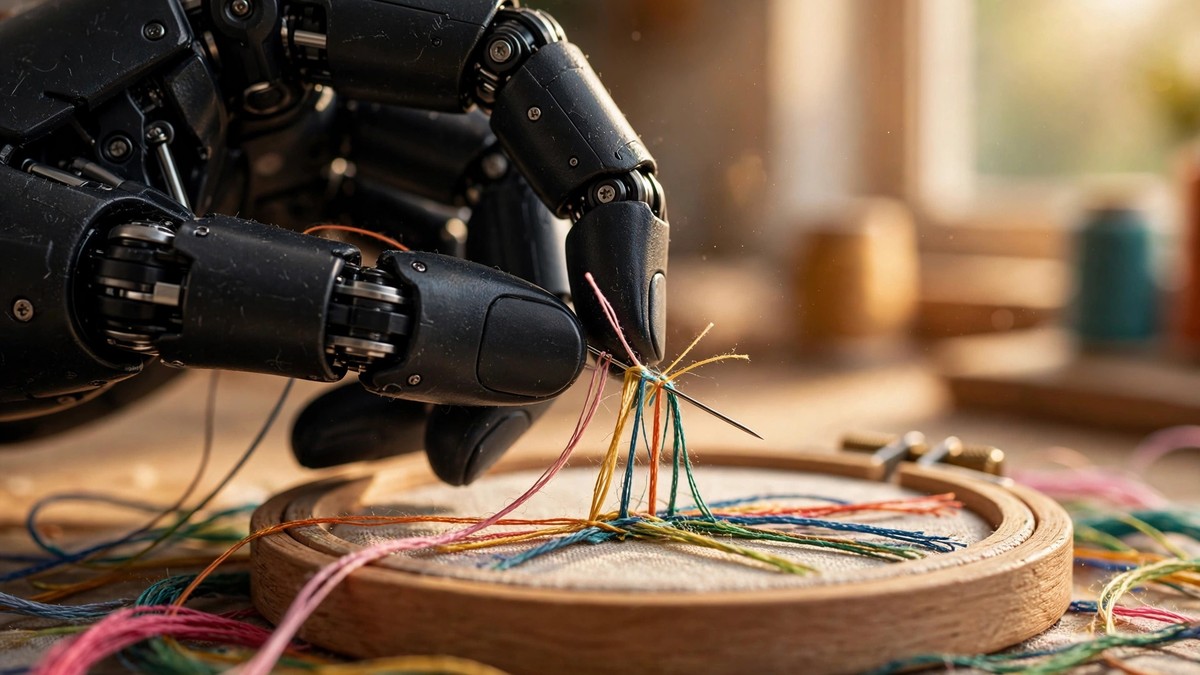
A robot hand has learned to thread a needle. Chinese firm AGILINK taught its OmniHand 3 Ultra the foundational moves of Suzhou embroidery, one of China’s most delicate traditional crafts. The teacher was master craftswoman Fu Xianghong, who showed the machine how to separate silk threads, thread a needle, stretch fabric on a hoop, and lay down stitches.
The hand itself is serious engineering. It has 21 active degrees of freedom, which means its fingers and wrist can move in 21 independent ways. It uses a direct drive architecture, and its fingertips, pads, and palm carry vision based tactile sensors. In plain words, the robot hand can feel what it touches while it watches what it does.
AGILINK spun out of AGIBOT in January 2026 to focus on dexterous hands. The company says it has shipped more than 15,000 hands so far, and its machines won medals at the World Humanoid Robot Games in August 2026. The embroidery announcement arrived on September 30, 2026 through PRNewswire as a company release, so every claim in this story comes from AGILINK itself. The release includes comments from AGILINK CEO Qiao Tianjie, who also serves as a vice president at AGIBOT. Asia News Today republished the announcement, and ohsem.me covered the milestone in detail.

The demo builds on a wider boom in Chinese robotics. AGIBOT recently built its 20000th robot as the country’s humanoid push speeds past rivals. UBTech’s Walker S2 can swap its own battery for round the clock factory work, and cheaper humanoid robots are already heading into homes and schools.
What the Robot Hand Demo Really Shows
Watch what the robot hand actually does and the achievement is clear. Threading a needle needs softness and precision at the same time. Pull too hard and the silk snaps. Grip too loosely and the needle slips. A machine that can separate a single silk thread and guide it through a needle’s eye is showing fine motor control that was out of reach a few years ago. Stretching fabric evenly on a hoop and stitching in rhythm adds timing and touch to the mix.
That mix of touch and timing is the real story. Most robot hands are strong but clumsy. They can lift boxes and turn wrenches. Delicate work like embroidery asks for something rarer, the ability to adjust force hundreds of times per second based on what the fingertips feel. The vision based sensors on this hand are built for exactly that kind of feedback.
A Skilled Demo, Not a Masterpiece
It is worth saying plainly what this is not. This is a company announcement, not independent reporting. The robot hand performed foundational techniques in a choreographed demo. It did not master embroidery the way Fu Xianghong has through years of practice and judgment. PR videos show the best take, not the average one. None of that erases the engineering, but it sets the right frame. A demo proves what is possible. It does not prove what is ready.
Demos like this still matter. They pull research out of the lab and give it a human shape. A robot hand that can handle silk today might handle surgical thread or tiny electronics tomorrow. The path from craft demo to useful work is long, but every step on it starts with someone asking what else a careful hand could do. For now, the embroidery hoop is both a stage and a test bench.
The choice of embroidery was smart storytelling too. Anyone can picture a needle and thread, so anyone can grasp what the robot just did. A lab benchmark with a number means little to most people. A threaded needle means everything. That is why the video travels so well on social media, and why the demo will be remembered longer than a spec sheet.

The MES Times Take
There is something moving about a machine learning from a master craftswoman. Technology often races ahead and leaves tradition behind. This time it stopped, watched, and tried to learn. The robot hand will not replace the artist, and that was never the point. The point is that careful work is worth copying. “The hand that learns gently will one day heal gently too.”
Read also: Four Robot Dogs Start a Six Month Trial at Pittsburgh Airport
Read also: Figure’s Retired Humanoid Robots Take a Terminator Style Leap Into Molten Steel
