
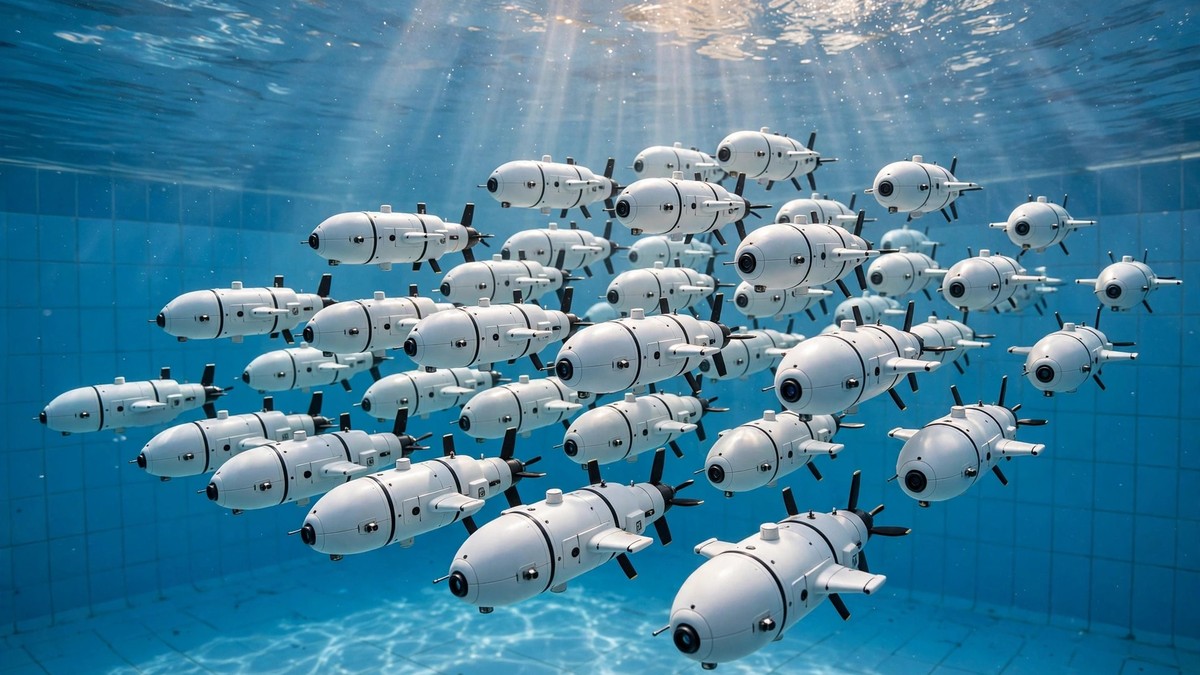
A swarm of underwater robots has just made history in China. A team from Northwestern Polytechnical University and Xi’an Tianhe Maritime Technologies sent 116 autonomous drones swimming together in formation. Guinness World Records has certified the feat as the most autonomous underwater vehicles operating at the same time.
The trial took place on August 29 2026. After the drones were placed in the water one after another, the underwater robots navigated a preset route for 34 minutes. They covered about 500 meters, or 1,640 feet. No human touched the controls once the run began. Guinness officials watched the whole attempt and confirmed every detail.
One detail needs to be clear, because the viral images suggest open water. The test happened in a swimming pool measuring 50 by 20 meters, not in the ocean. Every source confirms the pool setting. The achievement is real, but the setting was controlled, and honest reporting should say so upfront.

Meet the TH-618 Drones
The vehicles are called TH-618 drones. Each one is 61.5 centimeters long and weighs about 5.14 kilograms, small enough to lift with one hand. They can travel about 30 kilometers on a charge, with a battery that lasts more than eight hours. They navigate with camera based vision, reading what they see instead of relying on GPS, which does not work underwater.
According to Interesting Engineering, the swarm moved as a coordinated group without a central controller barking orders. Each drone made its own decisions while staying in formation with the rest. That is the hard part. One hundred and sixteen independent machines, one shared plan, zero collisions.
The university announced the Guinness certification on September 24 2026, and media coverage followed in late September. TechJuice and News Darpan both reported the record, carrying the story to audiences across Asia.
Building small underwater robots is harder than it looks. Water blocks radio signals, so the drones cannot phone home for directions. They must think for themselves down there. The TH-618 answers this with cameras and onboard software that read the water in real time. Each robot sees, decides, and swims, all on its own.
Sequential deployment was the key trick. The team released the drones into the water one by one, and each newcomer found its place in the moving formation. By the time all 116 were swimming, the swarm looked like a single living creature gliding through the pool.
Records like this do more than fill a certificate. They prove that large groups of underwater robots can work as a team in the real world. Engineers watching the pool saw the future of ocean work taking shape. Inspection, mapping, and search missions all become cheaper when underwater robots cooperate instead of working alone.
Why Underwater Robots Matter in Swarms
Swarms like this could one day do serious work. They could inspect underwater pipelines for leaks, map the sea floor in fine detail, or search for missing objects across wide areas. One drone can only see a small patch of water. A hundred drones can cover a bay. The math of swarms is the math of teamwork.
China is moving fast across all of robotics. AgiBot recently built its 20,000th robot as the humanoid boom speeds past rivals, showing how quickly the industry is scaling up. The underwater robots record is one more sign of that momentum.
But viral robot stories deserve a careful eye. Reports of a Chinese gestation robot recently turned out to be false, which is exactly why honest details matter so much. A pool is not an ocean. Saying so does not shrink the achievement. It protects it.
The same autonomy is showing up on land too. The biomimetic AI robot Moya now walks with 92 percent human like accuracy, and BYD has unveiled a robot that can charge EVs on its own. Machines that work without supervision are becoming normal.

The MES Times Take
One hundred and sixteen machines moving as one, with no hand on the controls, is a glimpse of the future arriving early. The pool may have been small, but the idea is ocean sized. Coordination is the real breakthrough here, not just numbers. Anyone can build many drones. Teaching them to swim together is the magic. The future will not arrive with a single giant robot. It will arrive as a swarm.
Read also: Chinese Robot Hand Learns Traditional Embroidery by Threading Needles
